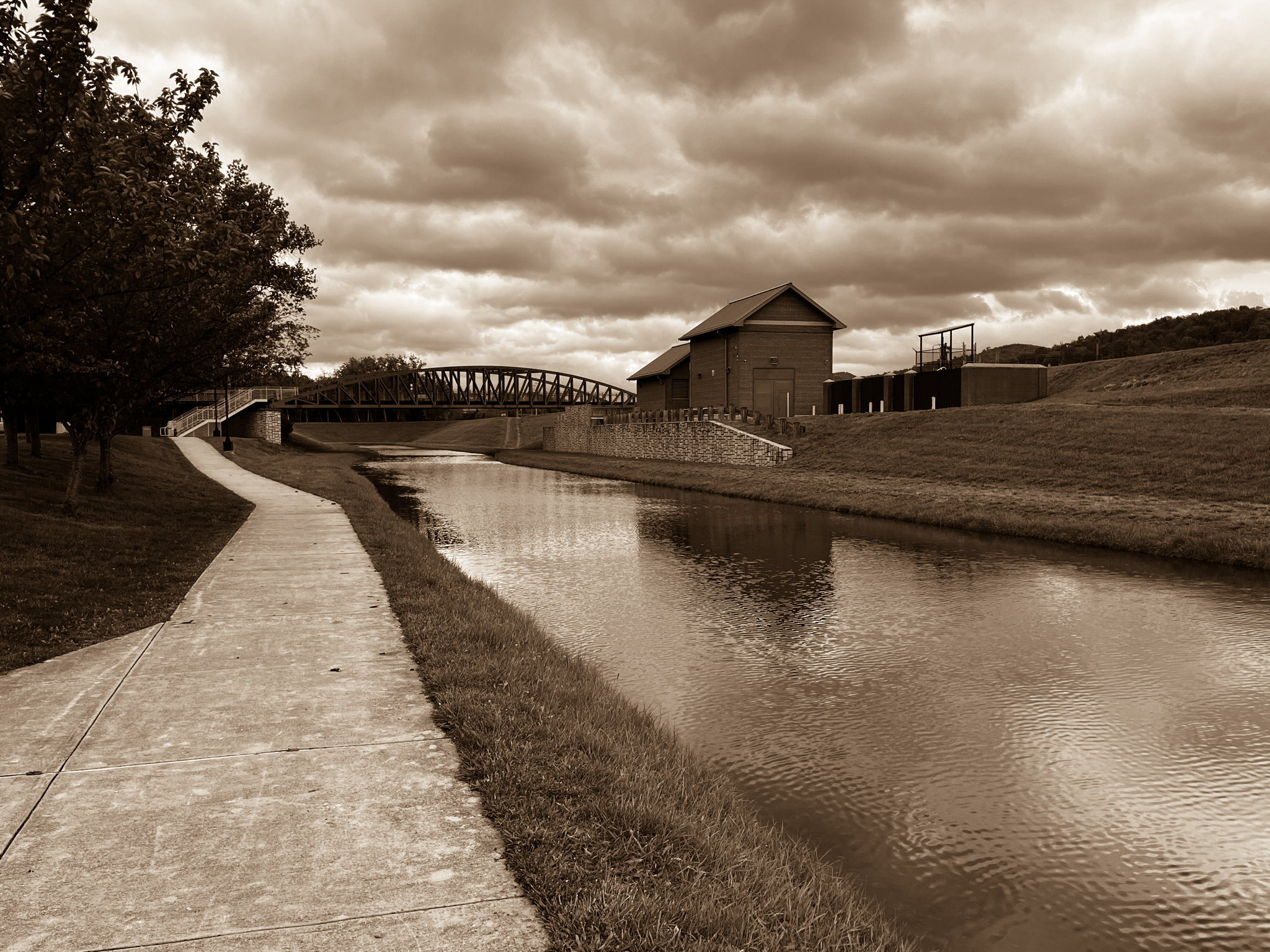
“What I do is the opposite of building walls. I build bridges. A bridge is something that connects instead of separating.” – Santiago Calatrava
Bridges have always facinated me. They’re engineering and art rolled up into one bare and essential structure meant to transport us from one place to another. And who knows more about bridges and their amalgamation of art and engineering than Santiago Calatrava. His bridges are majestic but solemn statements of artistry, technology, and ingenuity. And as Calatrava’s statement implies, bridges art not just utilitarian, but connect us together in many ways more than we think. They help stitch cites together.
On a recent work trip to Cleveland, while walking from the hotel to an evening reception, I had the lucky chance to see three of Cleveland’s most distinguished bridges over the Cuyahoga River up close and personal. Today’s bridges are sleek, modern, bare expressions of their building technologies. These bridges over the Cuyahoga in downtown Cleveland have a certain elegance despite their weightier and more grounded appearance. They certainly took thought, design, and engineering. They looked facinating.
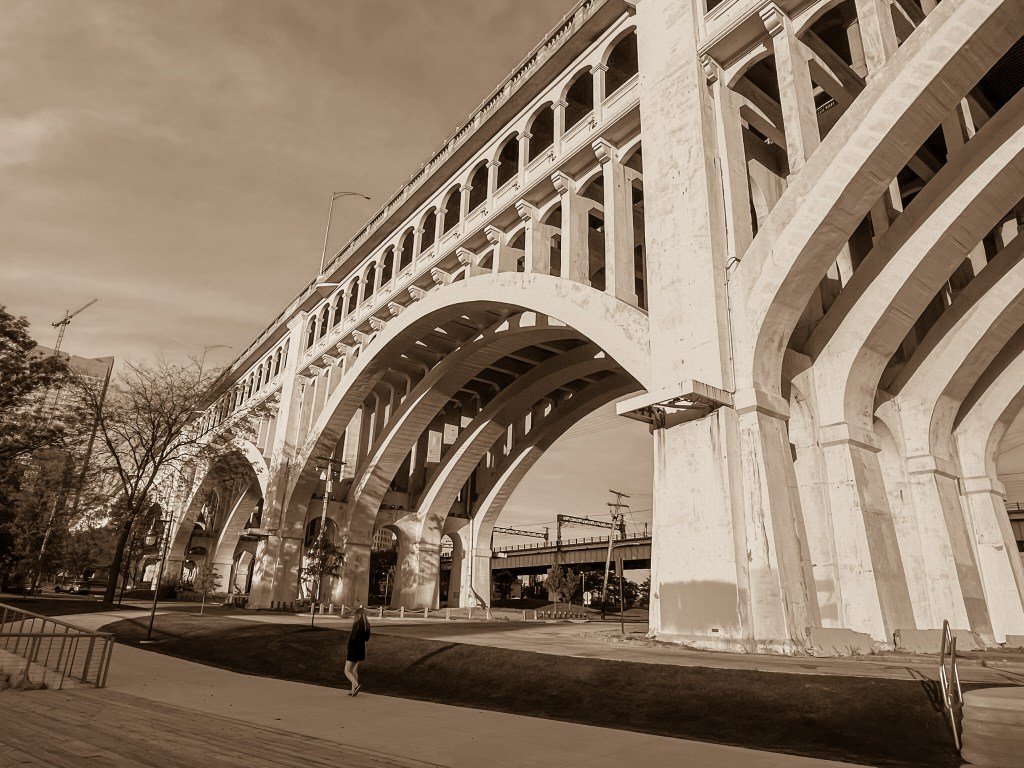
The first of these as I walked along the Cuyahoga riverfront was the Detroit-Superior Bridge, known locally as the Veterans Memorial Bridge, and constructed between 1914 and 1918 in steel and concrete. It was for a time the largest double-decked reinforced concrete bridge in the world, built for $5.4 million. Connecting to the Public Square in downtown Cleveland on the east to West 25th Street along Detroit Avenue, the bridge’s twelve arches, simple and lean, stretch well into the horizon from my vantage point below along the riverfront. Within the arches are alternating rows of piers and smaller arches that support two traffic decks above, the top deck used by cars, and the bottom a now-defunct right-of-way for streetcars. That deck was in operation up until the 1950s. The piers and arches look thin and weightless. It’s hard to imagine how they support the two traffic decks.
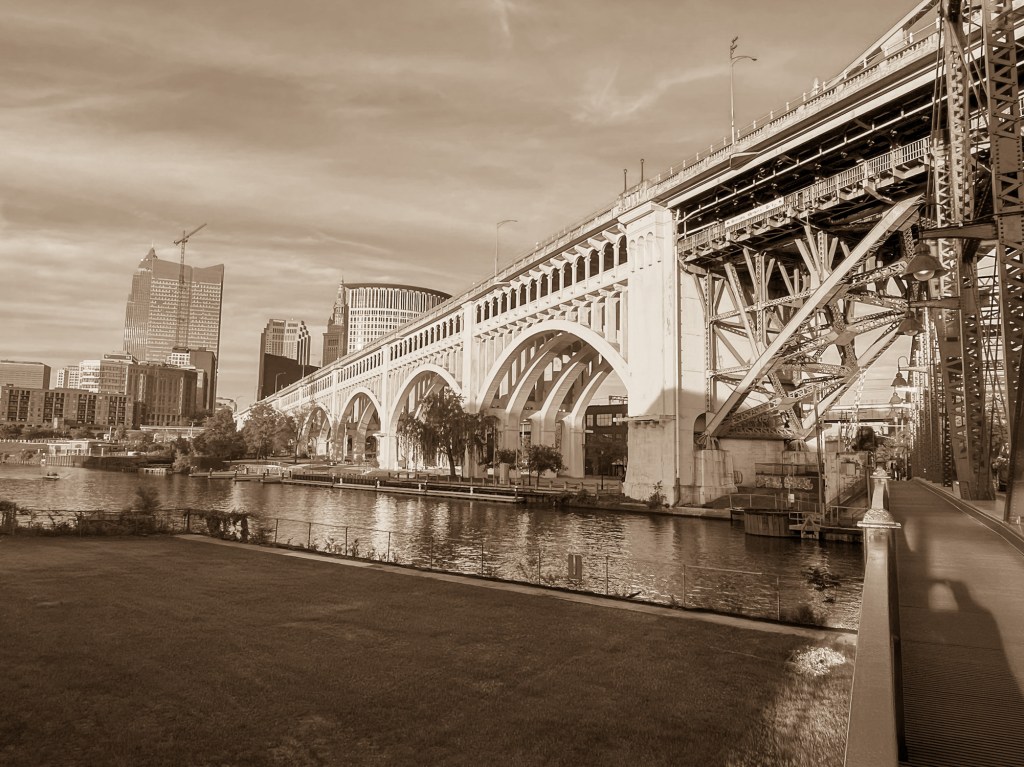
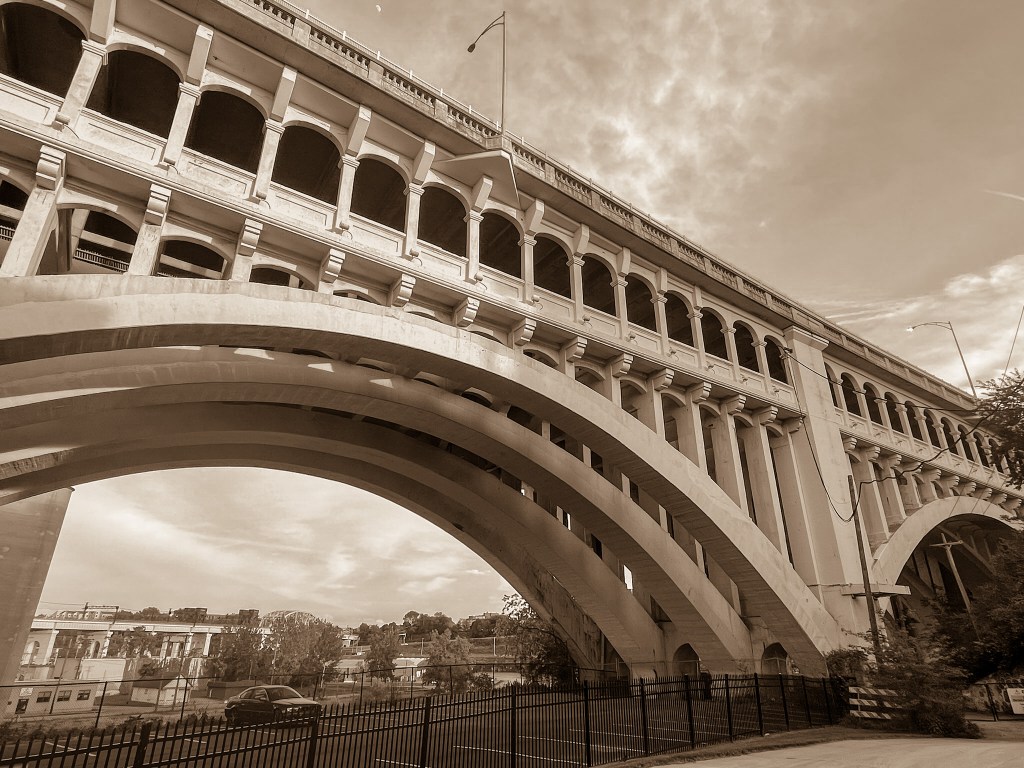
Interestingly, while the lower deck has remained largely closed for transportation use for the last several decades, it has from time to time been the scene of various special events. In 2019, the lower deck hosted a large-scale public art installation by the UK-based arts collective Squidsoup, organized in part to celebrate the Cuyahoga River’s clean-up and emergence as a public waterway – a far cry from its hey-dey as as Cleveland’s industral waste container. If one recalls, the Cuyahoga actually combusted in the late 1960s.
One can access the bridge’s undersides at Settler’s Landing Park right along the Cuyahoga next to the downtown Warehouse District. The park commemorates the landing site of Moses Cleveland and his Connecticuit Land Company surveyors as they came to explore this new ground in the late 1790s. A mural located on one the bridge’s piers depicts scenes of canal workers plying the Cuyahoga. At least that is what I think it means – there are no markers for the mural.

The second bridge on my walk was one I did not see up close but across the Cuyahoga to the west of the Detroit-Superior Bridge. This one, a “jacknife-bascule” bridge with a span of 255 feet, was built for the Baltimore Railroad in 1956. The bridge, officially the Baltimore Railroad Bridge #463, which carries one single track on a 22-foot width, is an imposing example of the kind. When the bridge opens, the span pivots around one end, pointing upward as if it was ready to transfigure into a rocket ship gantry. The bridge was upright when I visited and I’m unsure if trains still run along it. To me at least, it stands as an icon – you cannot miss it when walking along the Cuyahoga riverfront. I wanted to get a more intimate view of the bridge but time was running short and I had to move on.

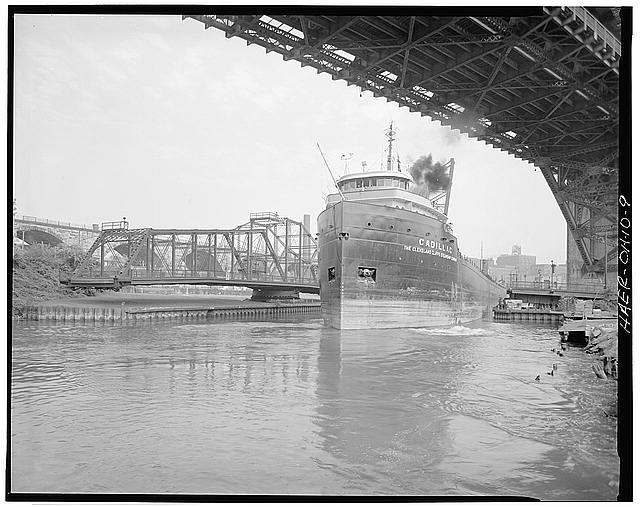
My last bridge on my tour along the Cuyahoga River was the Center Street Bride, constructed in 1901 and the oldest of the three I photographed on my walk. It features a steel truss framework on top of a rim-bearing “bob-tail” that allows the bridge to pivot on a land-based pier. This construction technology dates to 1853, pioneered by the King Bridge Company, a major builder of such bridge types in the Cleveland area well into the 20th century. The bridge, located just under the Detroit-Superior Bridge, connects the Irish Bend neighborhood on the east to the Flats on the west, a once thriving steel manufacturing complex, now a gentrifying neighborhood.
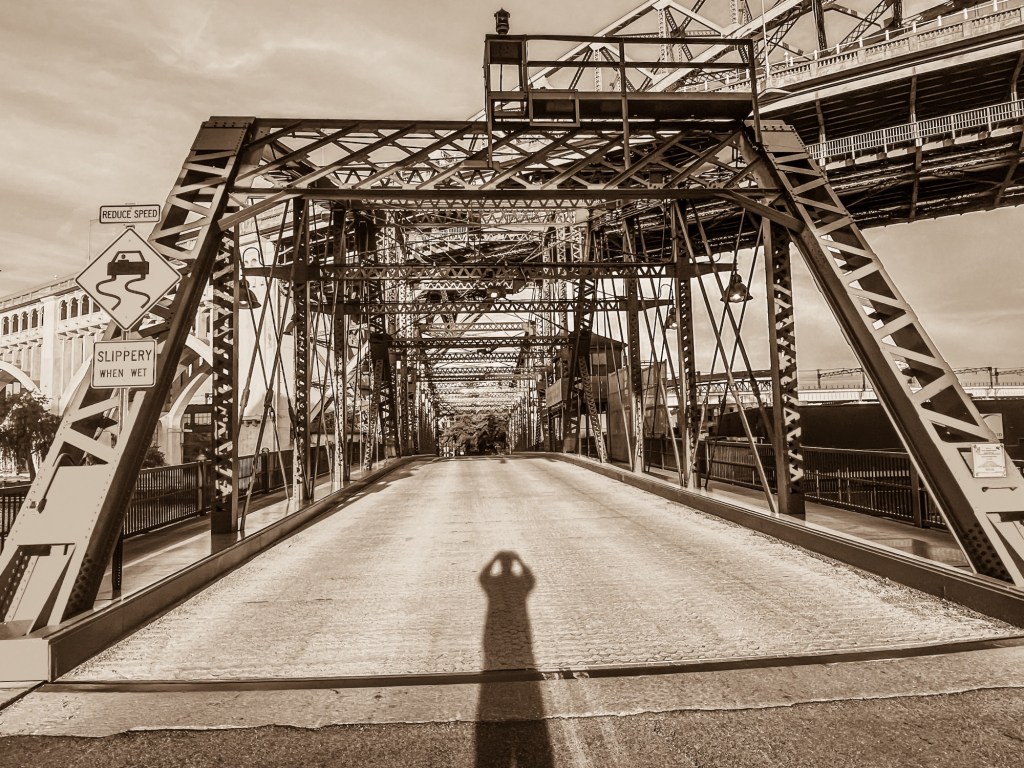
Painted a fire hydrant red, the Center Street Bridge has undergone several rehabilitation schemes over the decades to continue its serviceability, the most recent in 2023. This rehab has given the bridge an almost immaculate appearance- like it was just built yesterday. The Historic American Engineering Record has several fascinating photos of the Center Street Bridge at work. They are worth a look.
Speaking of beautiful bridges, I did not get a chance to see the Hope Memorial Bridge on this trip – the one with the famous carved Art Deco “guardians” that adorn it. That’s for another visit. But Cleveland’s bridges tell its story. They connected places and gave Cleveland a distinctive feel. They have long and will continue to connect the city together, just as Calatrava would want.
Source for background information: Bridges and Tunnels website.
Historic American Engineering Record, Creator, King Bridge Company, James Ritchie, James T Pardee, L.P. And J.A. Smith Company, Allis-Chalmers Company, and Carol Poh Miller, Lowe, Jet, photographer. Center Street Swing Bridge, Southwest of Public Square, Cleveland, Cuyahoga County, OH
. Ohio Cuyahoga County Cleveland, 1968. Documentation Compiled After. Photograph. https://www.loc.gov/item/oh0108/.
 The Places of Sense Chronicles
Leave a comment